6 Steps to Properly Clean Your Dryer

Cleaning a dryer is an important maintenance task that helps extend the life of the appliance, improve its efficiency, and reduce the risk of fire. You may have just started using a dryer, or switched to a model that differs significantly from your previous one.

Disclaimer: First of all, open the manual that came with your dryer and read the maintenance instructions specific to your model.

What the maintenance checklist depends on

In short, the checklist varies depending on the model. Key differences include:

  • Connected to a drain or not — if there is no drain connection, you will need to manually empty the water tank.

  • Ventilation system presence — if there is an air outlet, the ventilation duct requires regular cleaning.

  • Type of condenser (heat exchanger) — it may be removable (washable under water) or fixed (cleaned with a brush/vacuum or compressed air).

  • Presence of a heat pump — models with a heat pump require more delicate (dry) cleaning, without water.

  • Lint filter cleaning — mandatory for all models, regardless of type.

Important: difference in working principle

  • Condenser dryers heat air with a heating element, then hot air passes through the wet laundry to evaporate moisture. The humid air is then cooled in a condenser, water is collected in a tank, and the air is reheated. This process is simple but less energy-efficient.

  • Heat pump dryers work like reverse refrigerators. They use a refrigerant and a closed loop to circulate air, removing moisture multiple times through the heat exchanger without losing heat. The drying temperature is lower, and energy consumption is significantly reduced.

While both types may look similar, their efficiency and maintenance differ considerably.

Serious Dryer Problems?

If your dryer is not heating, won’t start, or regular cleaning doesn’t solve the issue — don’t worry. Our certified technicians can help with dryer repair at your home. We use only original manufacturer parts to ensure safe and long-lasting repairs.

1. Lint Filter Cleaning

Frequency: After each drying cycle.

Steps:

  • Open the dryer door and locate the lint filter (usually at the bottom of the door opening or inside the door itself).

  • Remove the filter.

  • Remove lint by hand or with a soft brush.

  • Wipe the filter with a damp cloth if there's any fabric softener residue.

  • Let the filter dry completely and put it back in place.

Properly clean dryer

2. Air Duct Cleaning (if vented to outside)

Frequency: Every 2–3 months.

Steps:

  • Unplug the dryer from the power outlet.

  • Disconnect the air duct at the back.

  • Clean the duct manually or with a vacuum cleaner.

  • If needed, use a long-handled brush.

  • Ensure the duct is undamaged and securely reconnected.

3. Condenser Cleaning

Frequency: Once or twice a month.

Without Heat Pump (regular condenser dryers)

Steps:

  • Open the lower front panel (usually with a latch).

  • Remove the condenser unit (if designed to be removable).

  • Rinse it under running water (do not use detergents). If access is limited, you may use a vacuum cleaner with a soft brush or a manual brush. Outdoors, compressed air or an air compressor can be used at low pressure — be careful not to damage the thin aluminum fins. Always check your model’s manual before attempting this.

  • Let it dry completely and reinstall.

Not all models have a removable condenser. If it's fixed, follow the manufacturer's instructions.

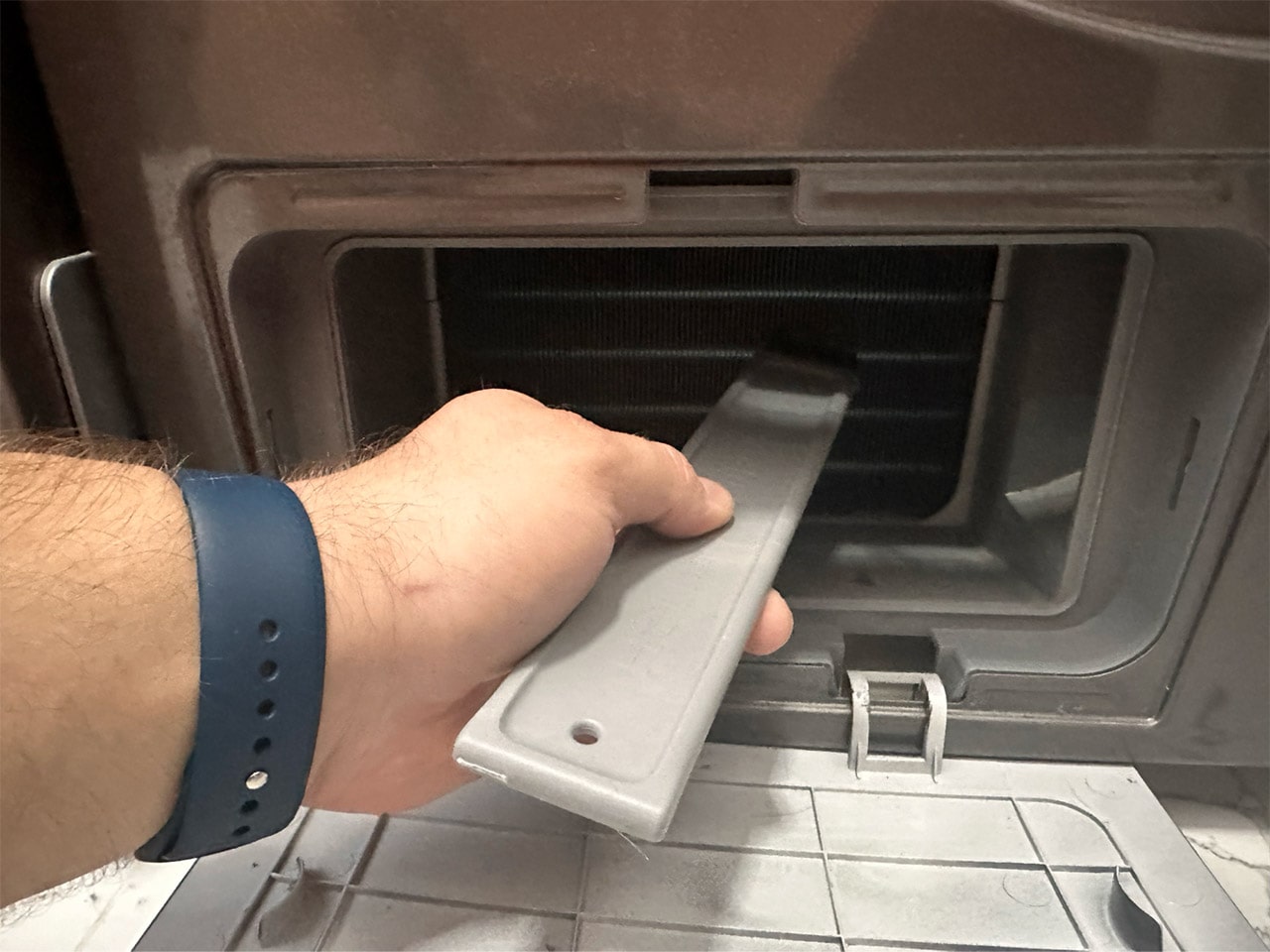
With Heat Pump (e.g., Samsung heat pump dryers)

Notes: These dryers often have a non-removable condenser accessible through a lower front panel. A special brush is often included in the kit.

Steps:

  • Open the heat exchanger compartment door.

  • Use the included brush or a soft brush to remove visible lint and dust.

  • You can also use a vacuum cleaner with a soft-bristle attachment — clean gently along the fins without pressure.

  • Close the panel and ensure everything is secured.

Never wash the heat exchanger with water unless the manual explicitly allows it — it may cause damage in heat pump models.

Properly clean dryer2 min

4. Drum Cleaning

Frequency: Once a month or if odor appears.

Steps:

  • Wipe the inside of the drum with a damp cloth and a small amount of vinegar or mild detergent.

  • Dry any moisture with a clean cloth.

  • Leave the door open for ventilation.

5. Water Tank (if no drain connection)

Frequency: After every cycle (if your model uses a water collection tank).

Steps:

  • Remove the tank.

  • Empty the water.

  • Rinse and dry the tank.

6. Additional Tips

  • Humidity sensors can be gently wiped with alcohol or a damp cloth — they are usually thin metal strips inside the drum.

  • Dryer exterior can be cleaned with a soft damp cloth.

  • Never use abrasive cleaners — they can damage surfaces and sensors.

Common Issues

  • Unpleasant odor — wipe the drum with a cloth moistened with vinegar or mild detergent. Always leave the dryer door open after each cycle to ventilate.

  • Loud humming or noise — check and clean all filters: lint, heat exchanger, and, if applicable, the ventilation duct. Clogged filters increase air resistance and noise.

  • Error messages or warnings on the panel — follow the instructions on the display. Usually, this means you need to empty the water tank or clean the filters. If the issue persists, refer to the user manual for your specific model.

+

Request a call

Please leave your contact details.
The manager will contact you shortly.